Showing posts with label African Dishes. Show all posts

Saturday, May 29, 2010

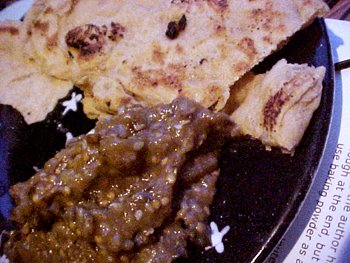
Ethiopian Yams - Yum.

Saute in olive oil (until yam is crisp):
  • 1/2 sliced onion
  • 3 minced garlic cloves
  • 1 tsp fresh minced ginger
  • 1 small sliced yam
Then add 1/4 sliced red bell pepper, saute another minute or so.

Add:
  • 2 Tbs split red lentils
  • 2 tsp tomato paste
  • 1 cup water
Bring to a boil.
Then add:
  • 3/4 tsp paprika
  • 1/2 tsp coriander
  • 1/4 tsp allspice
  • 1/4 tsp cinnamon
  • 1/4 tsp fenugreek
  • 1/4 tsk ginger
Cook ~20 minutes, until lentils are tender.

Add salt, serve. Yum. :-)

Thursday, April 19, 2007

Comoronian Rice Pudding with Pineapple

Comoros is a group of four islands off the east coast of Africa, north of Madagascar. They have bizarre animals. The coelacanth, a fish thought to have been extinct for millions of years, but still living in Comoros. The four-foot-long “flying fox” fruit bat. The islands were once a major supply stop for ships traveling around the tip of Africa, and their mixed African-Asian-European-Malagasy population reflects that. Most of the population farm bananas, rice, coconuts, ylang-ylang, and pineapples.

This recipe is from a UN book on rice recipes from around the world.

Comoronian Rice Pudding with Pineapple
Serves 6

4 1/4 cups milk
1 can pineapple slices (including juice)
3/4 cup rice
Pad of butter
1 pinch salt
1/2 cup cream
1 Tbsp sugar
2 Tbsp brown sugar

Preheat the oven to 350 degrees.

Boil the milk, add the rice and cook on very low heat for 1 hour. (Stir occasionally to make sure it doesn’t stick to the bottom of the pan). Then stir in the cream, pineapple juice, and sugar. Pour into a baking dish, cover with pineapple slices, sprinkle with brown sugar, and add butter.

Bake for 30 minutes & serve warm.

Tuesday, April 17, 2007

Oops - Back to the Tour: Burkina Faso

Sorry about that. Moved to St. Louis and forgot to blog for eight months. Still going around the world, though. Here’s Burkina Faso:

Peanut Butter Millet from Burkina Faso
Burkina Faso is classified as one of the hungriest countries in the world. Almost 40 percent of the population is chronically malnourished. Their infant mortality rate is 91%.

For perhaps all these reasons, I couldn’t actually find any recipes from Burkina Faso. They eat a lot of millet, sorghum, yams, peanuts, and a kind of pounded peanut butter millet mash called Tô (rhymes with dough). So I cooked some Tô and counted my lucky stars.

It was tasty, if odd. It tasted like peanut butter and millet.

Peanut Butter Millet from Burkina Faso
1/2 cup dry millet
1 cup water
1/4 cup peanut butter
Boil the water, stir in millet, reduce heat, simmer (covered) for ~20 minutes, until the millet has absorbed all the water. Stir in the peanut butter.

Monday, September 18, 2006

Burundi: Plantains and Beans

My mother just called.

"Oh hello sweetheart, guess what? I made that Okra Fried Rice you posted on your blog! It was fabulous!"

"What are you talking about, Mom, it wasn't good at all."

"Well, I omitted the okra."

"Ah."

"Also the soy sauce."

"Ok . . . "

"And I didn't have any fennel seeds, so I added parsley instead."

"Mom?"

"And I used bell peppers instead of onion."

"So when you said you made my okra fried rice . . . "

"It was really more of an honorary kind of thing. Oh! And I'm making your cashew lemon rice tonight!"

Sigh. Here is another strange dish that my mother is sure to mis-cook: Burundian Plantains and Beans.

This was a bizarre dish: filling and satisfying, but not particularly spectacular.

Recipe: Plantains with Beans
Serves 2

2 tsp oil
1/2 onion, sliced
1/2 cup cooked or canned kidney beans
1 green plantain (or a green banana), peeled and sliced
1/2 tsp salt

Fry the onion slices in the oil until they begin to brown, then add everything else and stir until the plantains begin to brown slightly. Add enough water to cover, and simmer over medium heat until the plantains are cooked all the way through. You might need to add more water if all of it evaporates. At the end, you should have a little water let over, but not too much.

Friday, September 08, 2006

Botswanan Greenleaf Vegetable

I found this recipe in a precious collection from ENO, an online community of schools from around the world. It was submitted by the Borwa Community Junior Secondary School in Botswana.

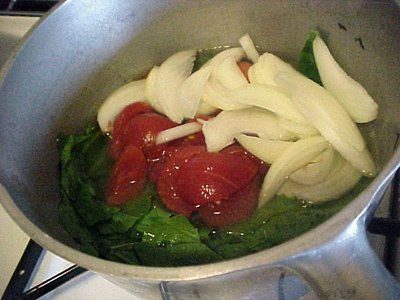
I wasn't enthusiastic about it ("No spices?"), but it was delicious. The sweetness of the onions and tomatoes was all the spice they needed.

Recipe: Botswanan Greenleaf Vegetable
Spinach
Onions
Tomatoes
Pepper
Water

“Instructions for the preparation: Cut the spinach leaves into small pieces. Slice some onions, tomatoes and peppers. Wash the spinach with clean water. Put the spinach into a pot together with the chopped onions, tomatoes and peppers. Pour half a mug of water in the pot and add some salt and spices and pour 2 teaspoons of oil. Cook for about 20 min. Keep the pot closed until the water dries up serve with rice.”

Wednesday, September 06, 2006

Jagacida: Rice & Beans Cape Verde Style

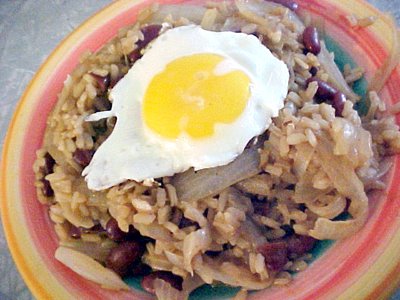
My 100th post! Time for a fried egg . . .

Toni Gifford submitted this recipe to the RecipeZaar 2005 World Tour, and it is tremendously delicious: warm flavors, satisfying textures, filling and tasty.

Recipe: Cape Verdean Jagacida
Serves 2

1/2 onion, sliced
1 Tbsp oil
1/2 Tbsp paprika
1 bay leaf
2 cups water
1/2 cup rice
1/2 cup cooked or canned kidney beans
Generous salt
1 fried egg

Warm the oil in a very large skillet, and sauté the onions in it until they are a light brown. Stir in the paprika and bay leaf. Add water, bring to a boil, and add rice. Lower the heat, add the beans, and simmer for about 20 minutes, until the water is absorbed. You will probably need to add a bit more water if the rice starts sticking to the bottom of the pan.

Serve warm, topped with salt and fried egg.

Friday, August 04, 2006

Peanut Butter Rice from Benin

Vodoo is the official state religion of Benin, where about 60% of the population practice it. It’s also one of the poorest countries in the world. When I read that their three major foods are corn, yams, and rice, I really wasn’t expecting much in the way of delicious recipes.

But it surprised me. This rice with peanut sauce is actually a fantastic combination.

Rice with Peanut Sauce from Benin
Serves 3

3/4 cup rice
1 Tbsp oil
1 Tbsp tomato paste
1/2 tsp salt
1/2 beef bullion cube (I used a veggie one)
1/2 cup water (or more)
1/4 cup peanut butter
1/4 cup diced onion

Cook the rice as per its packaged directions.

Meanwhile, heat the oil in a medium frying pan, and add the tomato paste, salt, onion, and bullion cube. Saute for a few minutes, then mix in the peanut butter and water. Bring to a boil, then lower the heat and simmer until the onions are soft, about 15 minutes (add more water if the mixture starts sticking to the bottom of the pan).

Pour sauce over rice and serve warm.

Friday, June 02, 2006

A New Twist on the Sugar Cookie: Algerian Semolina Sugar Cookies

The sugar cookie is the Barbie of the cookie kingdom: sweet but standard. Truth to tell, I rarely bake them. With nothing to make my taste buds cry hark, the sugar cookie recipe usually only comes out to play when I'm missing ingredients for anything else.

But this is different.

The semolina gives this cookie a texture unlike any I've ever tasted. It is strangely coarse and gritty, yet delicate. The interior is soft, moist, and chewy. The flavor is buttery and delicious.

The recipe is from the wonderful blog Ya Rayi Our Rai, written by California School of Culinary Arts chef Farid Zadi. I cut the recipe by 1/3, since I really didn't need that many cookies, and I added the almond halves and coarse sugar, because I think they're pretty.

Algerian Semolina Sugar Cookies
(Recipe has been cut by 2/3 – now makes about 20 medium cookies)

2 2/3 cups semolina flour
1/3 tsp baking soda
1 egg
1 1/4 cups sugar
1/3 cup + 1 tsp butter
1 tsp vanilla
1/2 cup almond halves, optional for topping
1/4 cup coarse sugar, optional for rolling

Preheat the oven to 350 degrees. Mix the dry ingredients together.

Beat the egg yolk and butter until light and fluffy. Add the sugar and beat some more. Add the vanilla. Mix the wet batter with the dry ingredients.

In a separate bowl, beat the egg whites until they are soft and puffy. Add to the rest of the dough and mix gently until it comes together. (If it won't, add a bit of water). (Zadi has a wonderful step-by-step slide show on his mixing method).

Pinch off walnut-sized pieces, shape into spheres, and place about 2 inches apart on an ungreased, parchment-lined baking sheet. Smush the spheres slightly to flatten. Roll the sides in coarse sugar and press four almond halves into the top to make a flower pattern.

Bake the cookies for 12 – 15 minutes, until light gold.

Tuesday, May 16, 2006

Morocco: Sesame Cookies


Moroccan cooking is a blessing upon the Earth, so richly flavored and textured that I could cook nothing but couscous dishes my whole life and be completely satisfied. I'll get back to some more couscous later, but today it's sesame cookies.

This recipe is a slightly modified version of one from Kitty Morse and Danielle Mamane's beautiful book The Scent of Orange Blossoms: Sephardic Cuisine from Morocco.

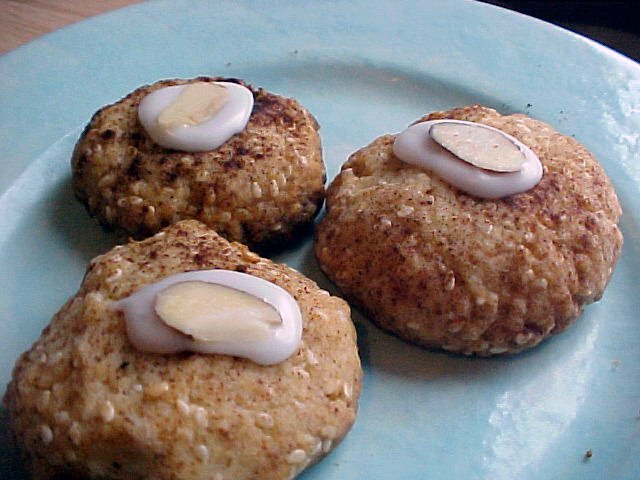
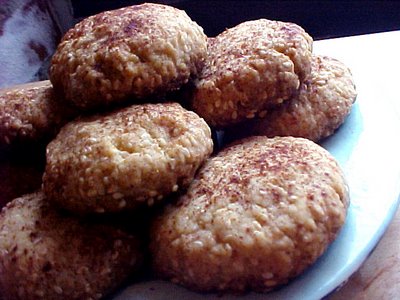
It's a very dry, coarse cookie, perhaps more like a sweet, crunchy, oily breadstick. When they came out of the oven, I didn't like them much, so I gave them an almond topping. Turns out, this was unnecessary: by the next day, they were so cool and sweet that they were a wonderful treat.

So let these sit overnight before eating them – they're much better the next day.

Makes about 15

1 1/2 cup all-purpose flour
1 tsp baking powder
1/2 cup plus 2 Tbsp vegetable oil
1/2 cup toasted sesame seeds
1/2 cup confectioners' sugar
1 tsp vanilla extract
2 Tbsp cold water

Topping
Cinnamon for dusting
1/2 cup confectioners' sugar
1 tsp water
1/4 tsp almond extract
15 halved almonds


Preheat oven to 375.

Mix oil, sesame seeds, sugar, and vanilla, then add flour and baking powder, then the water, mixing with fingers until the dough has formed coarse crumbs.

Roll the dough into 2-inch balls, flatten, and set on ungreased baking sheet. Sprinkle with a little cinnamon.

You can either press the almonds halves directly into the dough and bake them in, or cement them on later with the icing – take your pick.

Bake 20 – 22 minutes, let cool.

Mix the confectioners' sugar, water, and almond extract. Use the paste to glue the almond halves onto the tops of the cookies.

Let sit overnight.

Monday, May 15, 2006

Breakfast in Tunisia


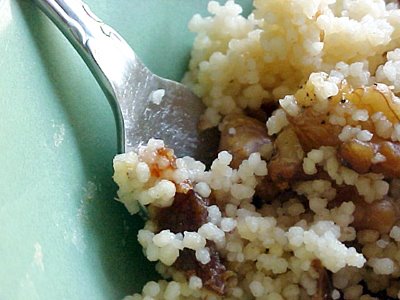
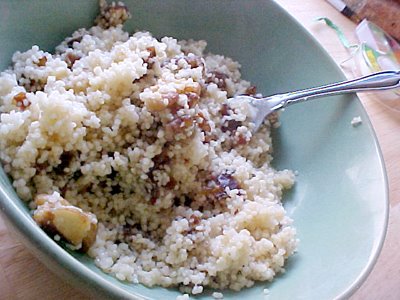
I had no idea my favorite breakfast food was from Tunisia. I suspect, since it's couscous, that it's popular throughout Northern Africa, but this version is called Tunisian Farka, so I guess it's mostly made in Tunisia.

It is outrageously sweet and delicious (despite the lack of added sugar), and the texture of the couscous and the crunch of the walnuts are enough to make anyone crumple up and trash their Lucky Charms boxes.

Tunisian Farka
Makes about 2 servings

1/2 cup couscous
1/2 cup water or milk
1 Tbsp oil
1/4 cup chopped, toasted nuts (I like walnuts the best)
2 ounces of chopped, pitted dates (about 10 dates)

Milk, butter, honey, or sugar for sprinkling over the top


Preheat the oven to 350 degrees F. Place the couscous in a medium-sized baking dish.

In a large saucepan, boil the water and oil. Remove from the heat and pour in the couscous. Cover and let it stand for 10 minutes.

Fluff with a fork to prevent it from solidifying into sticky mass. Mix in the nuts and dates. Cover with foil and bake about 20 minutes. Serve with milk, butter, honey, sugar, or plain (it's quite good plain).

Friday, May 12, 2006

Egyptian Baba Ghanouj & the Importance of Soaking Your Blender

This was my first time making baba ghanouj, that zesty eggplant dip, and I forgot to soak my blender. Cleaning up "later" had seemed like a good idea at the time (10pm last night), but by this morning the eggplant residue had cemented itself to the blender blades. Not my best laid plan.

("But you know," said my sister as I bemoaned my crusty blender, "Only one plan in your life will ever be your best laid plan. All the others will be less than best." - "Yes, but that one's sure to go awry." - "Hmm. So maybe this was your best after all.")

Anyway, should you make baba ghanouj, always soak your blender.

Here's the recipe (from Anna Thomas's The New Vegetarian Epicure):

Makes enough for 6 – 8
(This is a popular dish all over the Middle East, but according to Wikipedia the tahine variation originated in Egypt)

3 lbs firm young eggplants
2 medium onions
1/2 head of garlic
1 Tbsp olive oil
1/2 tsp salt
1 1/2 Tbsp tahine (sesame paste)
3 Tbsp lemon juice
pinch of cayenne

Roast the eggplant at 400 degrees for an hour, until the poor shriveled fruits collapse into a puddle of goo. Anna Thomas recommends scooping out the flesh and discarding the seeds and skin, but I like the seeds and skin, especially when blended into tiny bits by my crusty blender.

While the eggplant cooks, chop the onion and garlic. Cook them on low heat in a saucepan with the olive oil for about 45 minutes, until they are a soft, caramelized gold.

Combine collapsed eggplant, carmalized onion and garlic, and everything else in blender. Blend. Serve with pita bread. Soak blender.

Tuesday, May 09, 2006

Madagascar and the Weirdest Banana Bread I've Ever Baked

I've been reading a U.N. cookbook on rice. This is the recipe from Madagascar:
Riz aux Bananes
Serves 3-4

3 measures of rice flour
1 kg of bananas
1 tsp bicarbonate of soda

Preparation

"Mash bananas, put them in bowl and mix in the bicarbonate of soda. Add rice flour, little by little, until dough is liquid but thick. Depending on the consistency, not all the rice lour need be used.

"If you are able to find leaves from a traveller's palm, place small amounts of the dough in small leaves and fold the filled leaves to form a packet.

"Next, place the packets in a cooking pot and add water to the top of the packets. Cook them over medium heat until done, adding water to the pot if necessary. If you cannot get any traveller's palm leaves, put the dough in a bowl, cover the bowl, put it into a cooking pot with some water in the bottom, and cook in the bain marie.

"Stick a knife in the middle of the dough. If it is done cooking, the knife will come out clean.

Obviously, this is a recipe that is open for interpretation. I used 1 banana, 7 tablespoons of rice flour, and 1 teaspoon of baking soda.

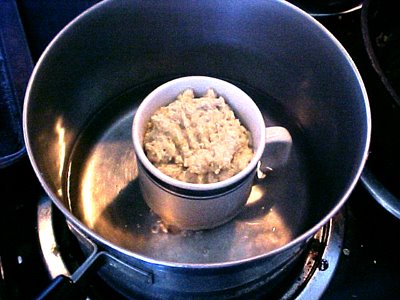
Since I had neither traveller's palm leaves nor a formal bain marie, I put the dough in a coffee mug (traveller's palm, right?) and the coffee mug in a saucepan of water.

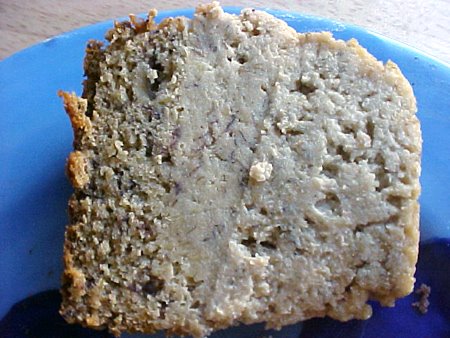
It came out looking like this:

That's rock-like on the bottom, moist in middle, raw on top. Not one to be put off by weird-looking bread, I sliced off a bit and ate it anyway. It tasted like rice flour mixed with banana then boiled in a coffee mug.

But it was pretty good toasted.